

The Minister for Agriculture approved the amendments to the 2019 Stable Fly Management Plan. The amendments were published in the Government Gazette on 28 July 2026 and are now in operation.
A Companion Guide has been published to help landholders understand their biosecurity and community obligations, and changes to the management plan.
Refer to the documents for all landholders below to view the Gazetted amendments, amended Stable fly Management Plan and Companion Guide.
Stable fly (Stomoxys calcitrans) is a blood feeding parasitic nuisance fly with a painful bite that causes pain and distress to people, pets and grazing animals.
Stable flies (also known as biting house flies, barn flies or power mower flies) breed in moist organic material such as manure, compost, grass clippings, and vegetable waste. They can travel to surrounding areas up to 20 km away and use their razor-sharp mouth to shred the skin and draw the blood of cattle, sheep and horses, people and pets. The pain and distress to the animals can result in animal welfare issues and production losses in commercial livestock.
They are a problem in Perth, Western Australia because the Swan Coastal Plain provides perfect conditions (sandy soils, temperate climate, rotting organic material and nearby hosts) for stable fly to breed in high numbers.
Infestations can limit recreational activities, outdoor work and impact our psychological wellbeing.
Managing organic waste is crucial to stop stable fly from breeding to protect our community and animals.
Stable fly management in WA: landholder responsibilities
Stable fly is a declared pest under the Biosecurity and Agriculture Management (BAM) Act (2007) in the following 15 local government areas on or near the Swan Coastal Plain:
- Cities of - Armadale, Cockburn, Kwinana, Rockingham, Swan, Wanneroo, Kalamunda, Serpentine-Jarrahdale
- Shires of - Capel, Chittering, Gingin, Harvey, with 2 new shires recently added to the declared area – Dandaragan and Victoria Plains
- and the portion of the Shire of Murray described as the Peel-Harvey Coastal Plain Catchment - State Planning Policy No. 2.1.
All landholders (including owner, occupier, or a person in control of land) in the declared area must, by law, (under section 30 (2) and (3) of the BAM Act) manage all organic waste on their properties using the prescribed control measures detailed in the amended Stable Fly Management Plan to mitigate stable fly breeding environments.
Failure to effectively control stable fly breeding may result in a fine of $20,000 or $50,000 if a Pest Control Notice is issued.
Although implementing measures to reduce stable fly breeding is a legal requirement, it also demonstrates a commitment to responsible land management and being a good neighbour. Consistent action helps build community trust and shows that the wellbeing of local animals, neighbouring properties and the wider community is valued.
By taking simple steps to minimise potential breeding sites, landholders can:
- Protect the lives of grazing animals, people and their pets.
- Play an active role in reducing stable fly populations across the region.
When everyone plays their part, even small actions can make a meaningful difference in reducing stable fly impacts and supporting the wellbeing of animals, neighbours, and the wider community.
Information for vegetable growers
Landholders/owners growing vegetables in the declared area must use the prescribed control measures to effectively to control stable fly breeding.
Any amount of vegetable waste and crop residues can become significant breeding sites for stable flies. Landholders have a biosecurity obligation to control stable fly breeding on their properties, and the best practice management strategies outlined below are the approved measures for achieving this.
By implementing responsible control measures on your property throughout your crop lifecycle you can protect your workers and neighbours from stable fly bites.
Weekly monitoring:
- Check for evidence of stable fly breeding (larvae or pupae) in all potential sources. If found, use an approved pesticide or bury the organic material to a depth of 1 metre.
After the crop matures there are several options to reduce stable fly breeding sites:
- Turn off irrigation (stable flies cannot breed in dry soil).
- Harvest as soon as possible including unsaleable items – waste material (stumps, stalks, leaves) makes a perfect environment for stable fly to breed.
- Deep burial. Bury waste material at least 1 metre deep to prevent fly emergence, or
- Mulch and desiccate. If large pieces of waste remain on or in the soil (root stumps), use a high-speed mulcher, then leave the waste to desiccate, or
- Cultivate the soil and waste on consecutive days for at least a week to expose the eggs and larvae to the sun, especially where the waste and soil have become compressed by wheel ruts. Check continually for larvae in these areas (moist and compressed).
- If larvae are present after this regime use an appropriate and approved pesticide.
After rain in the warmer months, monitor for the presence of larvae and pupae and use a pesticide treatment if larvae are detected.
Reject produce can be managed by:
- Feeding out to livestock in thin lines, in a feed trough or on hard surface (to avoid mixing with soil).
- Deep burial at least 1 metre below the surface.
Information for poultry owners
Untreated poultry manure is not be used on irrigated pasture.
The Plan requires written consent from the occupier of any dwelling within 500 metres before spreading untreated poultry manure.
Untreated poultry manure may be applied to non-irrigated pasture only when:
- it is spread immediately upon arrival
- manure particles are reduced to 20 mm or less
- application rates do not exceed 10 tonnes dry weight per hectare
- at least six weeks elapse between applications.
If untreated poultry manure contains stable fly eggs, larvae or pupae, or becomes wet, it must be treated with an approved pesticide.
Failure to comply with prescribed control measures is an offence under the Biosecurity and Agriculture Management Act 2007 and may result in penalties of up to $20,000.
- composting in accordance with Australian Standard AS 4454
- thoroughly mixing sodium borate at a minimum rate of 0.5% by volume before the manure leaves the production site
- thoroughly mixing calcium cyanamide at a minimum rate of 1% by volume before the manure leaves the production site.
Information for all animal owners - commercial and non-commercial (livestock, horses, cattle, sheep and pets)
If your property is located in an area where the stable fly is a declared pest, you must follow the control measures contained in the amended Biosecurity and Agriculture Management (Stable Fly) Management Plan 2019.
Stable fly is closely associated with human activity and can be a serious pest of livestock around animal enclosures, stables, feedlots and paddocks or pastures.
Stable flies mostly feed in the morning and again in the late afternoon when they can extract 5 times as much blood as a mosquito with each meal! The fly will make several attempts to feed, adding to the animal’s distress. Once settled on an animal, it takes 2 to 5 minutes to complete the blood meal, before seeking a shady place to digest it.
Cattle and horses are most affected. Animals will try to avoid the fly by stamping their feet, tail switching, throwing their heads down toward their front legs, and kicking sand up onto their legs and body. In large stable fly numbers, cattle will often bunch together to get to the centre of the group to avoid the flies, or they may stand in open water to avoid being bitten.
When large numbers of stable fly are present (as few as 10 per animal) they impact the animal’s ability to feed and care for itself. The constant movement of animals due to the agitation of the flies can lead to stress, dehydration, and weight loss.

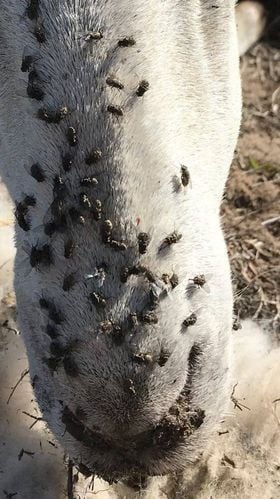
Photos: Stable flies impacting cattle and sheep
There is a choice of products to use to reduce stable flies landing on and biting cattle (backline pour-ons to insecticide-impregnated ear tags), as well as baits and residual sprays to use in feedlots and animal housing respectively, but they are only useful if used in addition to good farm hygiene practices. See a list of registered products available (compiled November 2025), but check for updates on the APVMA website.
Please note that most repellents may to last for a day or two, but reapplication is needed and it is recommended to use a variety of products to reduce stable flies becoming resistant to the products.
 Photo: Cattle bunch together when stable flies bite
When to report to your local government authority
Report stable fly infestations to your LGA when the animals are showing avoidance behaviours that prevent them from grazing, drinking and caring for their young.
If your local government is in the declared area and you are experiencing problems with stable fly, contact your local government authority and ask them to investigate the source of any infestations.
Please note that action depends on your local government's involvement.
Stable fly has several alias's including 'dog fly' as they often use dogs for a blood feed.
The following information focuses on dogs; however, the information applies to similar pets affected by stable fly.
One of the many common names for the stable fly is the 'dog fly' and for good reason as they can attack dogs as well as humans. The fly loves to bite and draw blood from the ears of dogs, where the blood vessels are very close to the skin surface.
There are numerous products on the market including sprays, repellents, creams, rinses and shampoos. Repellents do not kill the flies but are designed to stop them landing on and biting your dog. Most repellents only last from a few hours to several days at best.
Using a spray on your dog’s bedding and in and around their kennel and feeding area will keep flies away from where your dog rests/sleeps.
Additionally, some protection can be gained by dipping your dog’s blankets/bedding into a permethrin rinse, then allow the bedding to dry.
See a list of registered products approved for use against stable fly (compiled in November 2025), but check for updates on the APVMA website.
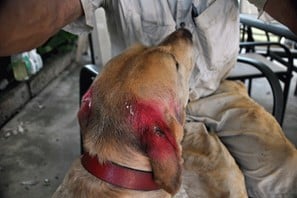
Photo: Dogs' ears can be bitten by stable fly bites
Ways to protect your animal if it cannot be kept away from stable flies
Alternative products to protect ears and body: Smearing one of several oil-based creams and repellents on the dog’s ears can protect them from stable fly bites. Vaseline, Nature’s Botanical Crème, dieseline and other oils can keep the flies away at least from their ears. The rosemary and cedarwood oils in Nature’s Botanical Cream are options.
Best practice for the management of manure: Dog manure is an attractant for stable flies although they rarely breed in this material because it quickly dries out, preventing larvae from surviving. However, it is always wise to regularly clean up and dispose of dog manure to prevent lots of nuisance flies from hanging around your yard, dog kennels and verandas.
Stable Fly Traps can be used to specifically catch and remove this fly from areas where dogs spend most of their time. Protein-based traps will not catch stable flies, but a whole other lot of nuisance flies including bush flies, house flies and blowflies that still annoy dogs, but not nearly as much as the biting fly.
Report stable fly infestations: If your local government is in the declared area and you are experiencing problems with stable fly, contact your local government authority and ask them to investigate the source of any infestations.
Please note that action depends on your local government's involvement.
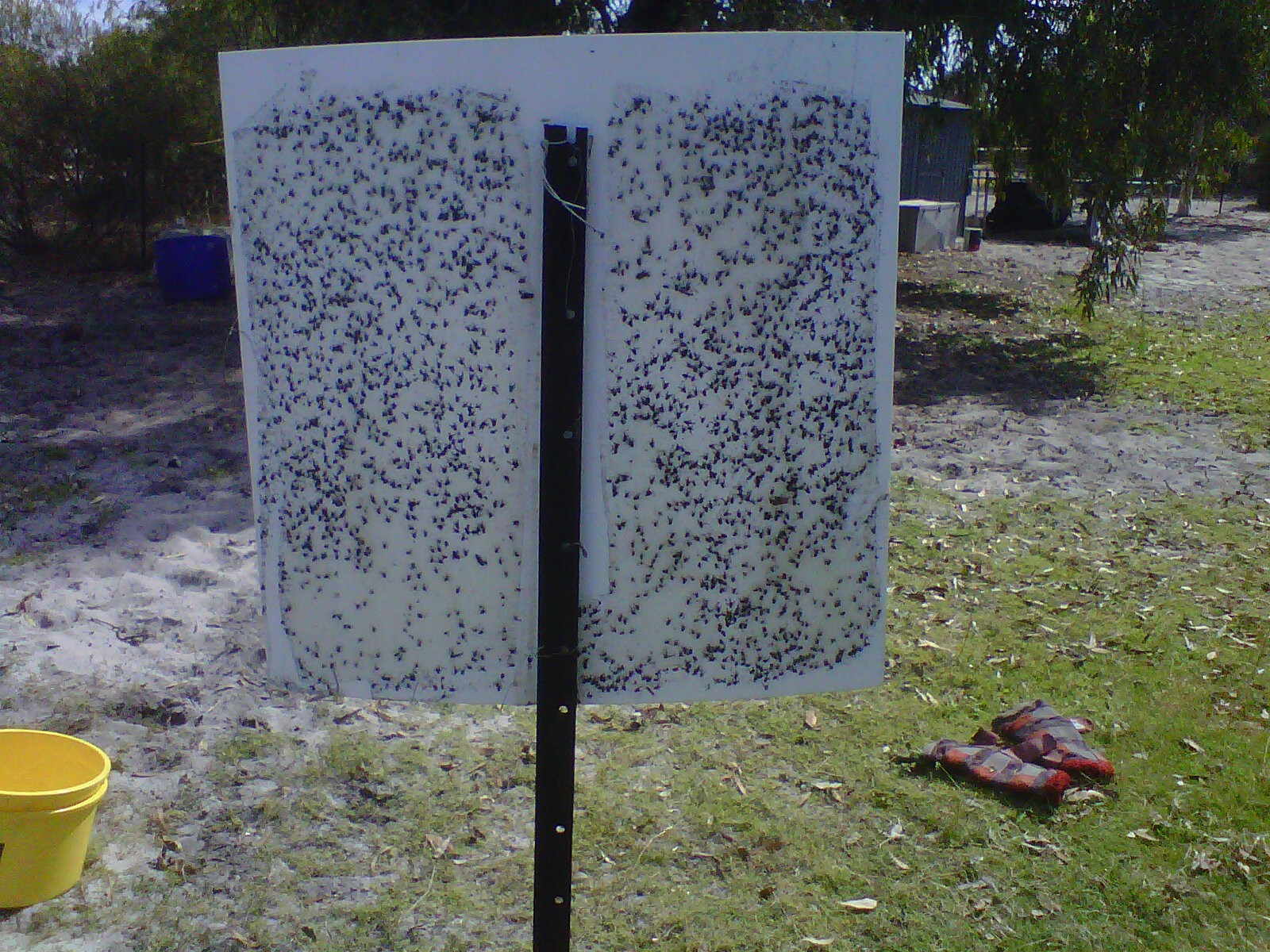
Photo: Sticky stable fly trap
Additional information:
As the common name 'stable fly' suggests, Stomoxys calcitrans is often found around horse stables. The fly breeds in soiled straw-based bedding, wet feed, aged manure, and uneaten but trampled hay.
| Manure, old feed and straw-based bedding - with no stable fly eggs, larvae or pupae | Manure, old feed and straw-based bedding - infested with stable fly eggs, larvae or pupae |
|
At least weekly: Remove old straw-based bedding and manure from stalls, pens and paddocks and either - (a) spread the material out thinly on the ground to dessicate or (b) compost or (c) deep buried to a depth of 1 metre. |
(a) Collect into a heap/mound and use insectide/pesticide, then leave undisturbed for 2 weeks to allow any emerging flies to contact the chemical residue/barrier spray. Note: Care should be taken in allowing animals to access these insectides for several reasons:
or (b) Cover and seal with black plastic and leave in sun for 2 weeks or until the eggs, larvae and pupae are dead, then spread material thinly on the ground to desiccate (chop into smaller pieces if possible). or (c) deep buried to a depth of 1 metre. |
Insecticides and repellents: There are a number of products available that can reduce stable flies landing-on and biting horses. These include backline pour-ons, insecticide-impregnated ear tags, as well as baits and residual sprays. These products can be useful, but only if combined with good farm hygiene practices.
Repellents do not kill the flies but stop them landing-on and biting your horse. Most repellents only last several hours, so given the large number of stable flies affecting horses around Perth, it is best to to use 3-4 different repellents, rotating to a different one every day. Nature's Botanical Cream (with rosemary and cedarwood oil) is particularly good at keeping stable flies off horses.
See a list of approved products (compiled November 2025), but check for updates on the APVMA website.
Alternative products to protect ears and body: Smearing one of several oil-based creams and repellents on the horse’s ears may protect them from stable fly bites. Vaseline and Nature’s Botanical Cream can keep the flies away at least from their ears.
Protective equipment: In combination with repellents, covering your horse with protective fly masks, body rugs (regularly rinsed in permethrin), and leg wraps may reduce the numbers of stable flies able to inflict bites on your horses.
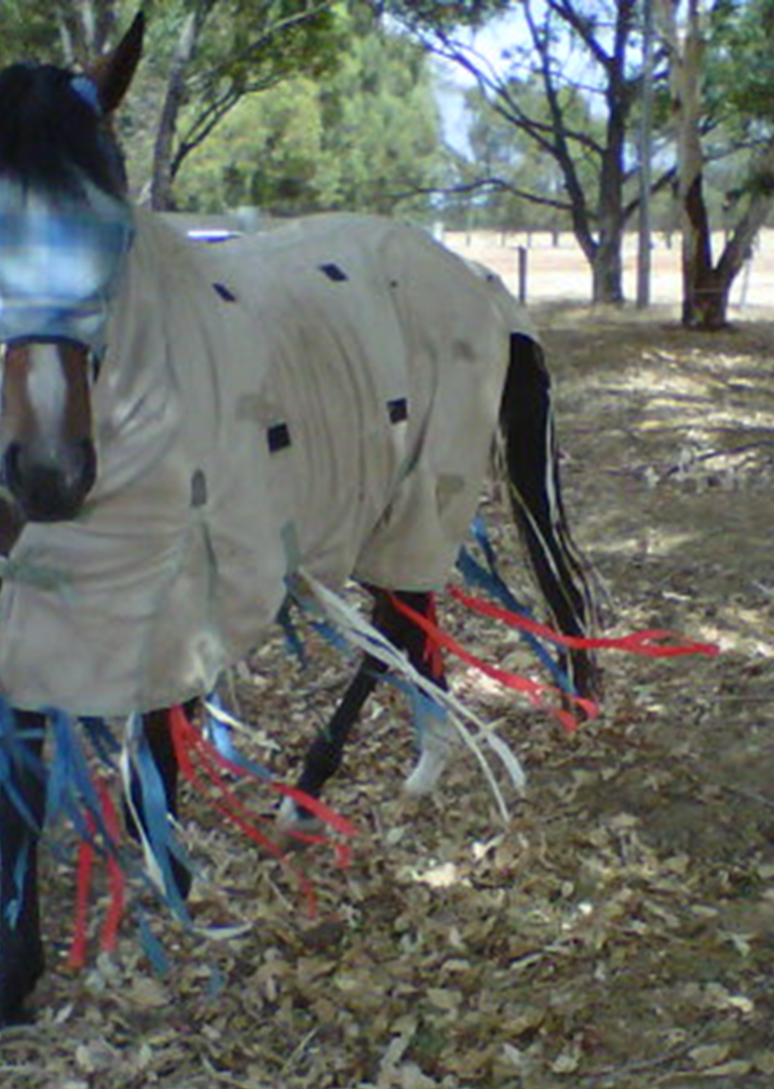
Photo: Tassels on horse rugs can prevent stable fly biting
Stable Fly Traps can be used to specifically catch stable flies fly from areas where your horses feed and spend most of their time, but treating the source of breeding is the most effective way. Note: Protein-based traps will not catch stable flies, but a range of other nuisance flies including bush flies, house flies and blowflies that still annoy horses.
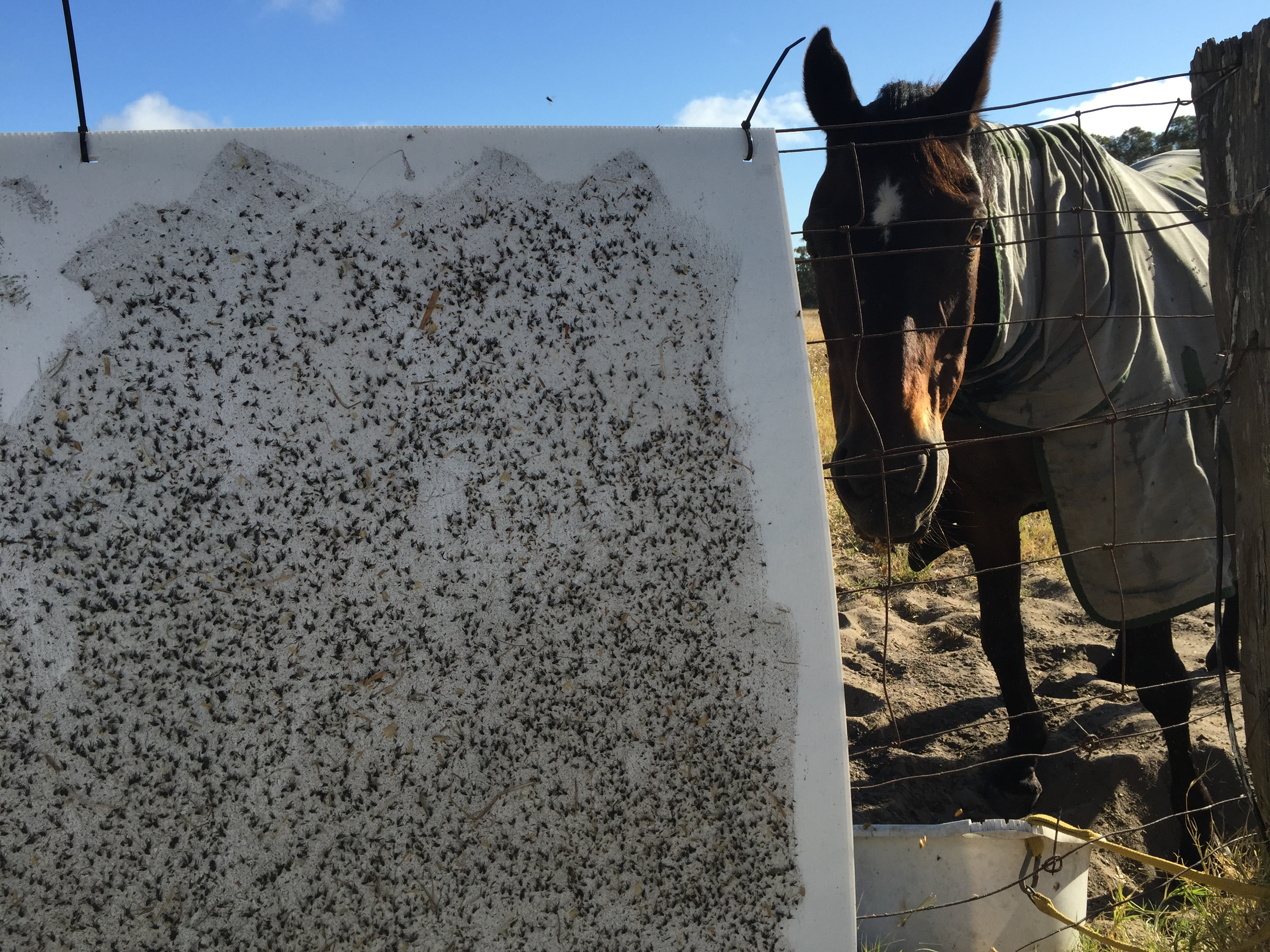
Photo: Sticky stable fly trap
Report stable fly infestations: If your local government is in the declared area and you are experiencing problems with stable fly, contact your local government authority and ask them to investigate the source of any infestations.
Please note that action depends on your local government's involvement.
Additional information:
Controlling organic waste is critical to reducing the impact of stable fly. To ensure that there are no breeding sites on your property, include these regular hygiene practices into your biosecurity plan:
- Feed vegetables to livestock in long thin lines, in a trough or box to prevent mixing with the soil.
- Regularly remove accumulated spilled grain feed and organic material in pens and yards.
- Weekly removal of animal manure and soiled straw accumulating in pens and yards, around water troughs and under fences, and gates.
- Stockpile animal manure for short periods (less than 3 days) before covering with plastic to protect them from getting wet.
- Cover animal feed and bedding waste with a fly-proof barrier and keep it completely dry with a tarp or plastic sheet.
- Spread animal manure and grass clippings into thin layers on the ground to dry out.
Note, hay that has been fed to animals, trampled into the soil, mixed with manure and urine, and exposed to the weather will take months to break down and may become a stable fly breeding ground. In this situation, hay must be either deep buried or sprayed with a pesticide and left undisturbed to allow emerging flies to contact the chemical residue/barrier. Spreading out this hay thinly will not kill the larvae. - Bury waste organic material (reject vegetable produce, manure, animal bedding, feed) and cover with soil to a depth of 1 metre.
Additional information:
How to protect your community and stop stable fly before they bite
See also information contained in the horticultural industry and vegetable growers section.
Note: If your property is located in an area where stable fly is a declared pest, you must follow the control measures contained in the Stable Fly Biosecurity and Agriculture Management plan.
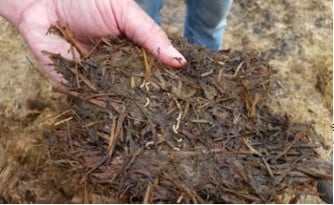
Photo: Rotting hay is a breeding ground for stable fly
Additional information
Stable fly is often confused with the common housefly (Musca domestica) and bush fly (Musca vetustissima).
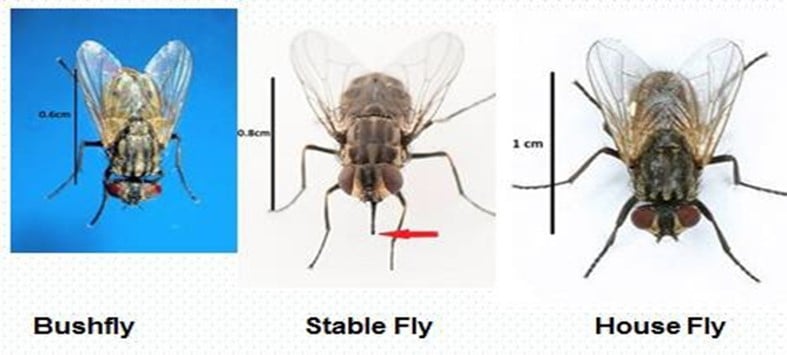
Photo: Comparison of the stable fly, bushfly and housefly
- It is slightly smaller than a house fly and slightly larger than a bushfly.
- has a checkerboard of dark spots on the back of the abdomen
- has a prominent black proboscis that is used to pierce the skin and draw blood.
Development stages
The lifecycle from egg to adult is about 13 to 18 days in temperatures ranging from 24°C to 30°C. At lower temperatures (10 to 20°C), such as those likely to be experienced over winter, development can take 3 to 5 months.
After ingesting a blood meal, the female fly lays around 90 eggs in 4 or 5 suitable locations, such as rotting vegetable matter or animal manure. She may lay up to 600 eggs over a lifetime and in warmer areas may breed year-round.
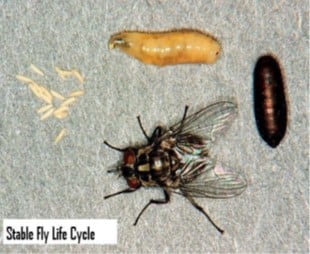
Photo: Stable fly lifecycle with eggs, larvae and pupa and larvae in rotting hay
In summer, the eggs hatch in as little as 20 hours and the active larval stages, which are extremely heat-tolerant, begin feeding for up to a week before pupating. The red-brown to black pupae are the size of a grain of rice, and can take as little as 5 days to emerge at high temperatures, or up to 30 days at lower temperatures.
After emergence, the adult flies disperse, sometimes covering up to 20 kms in search of a host animal. Both male and female adult flies feed on blood, as soon as 6 hours after emergence.
The adult flies live for about 3 to 4 weeks, with extreme heat (over 35°C) reducing their lifespan to just 2 weeks.
You can check to see if stable fly is breeding on your property by looking in any moist, decaying organic matter.
Stable fly larvae are usually found where rotting vegetable matter meets the soil. They are pale yellow to creamy white in colour and shaped like a cigar.
To locate them: look inside rotting vegetable root stumps, such as celery, cauliflower, or broccoli, or where organic material is in contact with the soil.
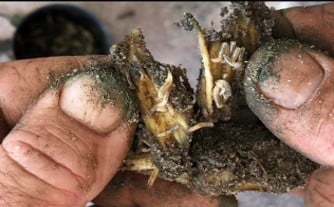
Photo: Stable fly larvae in rotting celery
When disturbed, the larvae will move away from the light but it may feign death for up to 30 seconds before moving.
Pupae are reddish-brown and barrel-shaped and are typically found in drier soil beneath or near decomposing organic matter. To find pupae, scrape through the soil to a depth of 5–10 cm and sideways about the same distance.
The best way to stop stable flies from breeding is to manage where their larvae grow by removing decaying organic material or turning off irrigation where there is rotting organic matter on the soil.
See our information sheet on how you can protect your community and stop stable flies before they bite.
If you find stable fly larvae, only use a pesticide approved for Use by the Australian Pesticides and Veterinary Medicines Authority.
Report any stable fly infestations to your local government authority.
The Stable Fly Action Group is an advocacy group made up of concerned and affected community members whose livelihoods and lifestyles have been affected by stable fly.
Australian Pesticides and Veterinary Medicines Authority (APVMA)
The APVMA's Public Chemical Registration Information System Search (PubCRIS) provides details about agvet chemical products including the product name, registering company, active constituents, product category (e.g. insecticide, fungicide or herbicide), and host and pest information.
If you have control measures in place to reduce the impact of stable fly breeding on your property, contact your local government authority and ask them to investigate the source of any infestations.
Please note that action depends on your local government's involvement.
Documents
- Stable fly management FAQs (743 KB)pdf
- Amended (Stable Fly) Management Plan (239 KB)pdf
- Gazetted amendments SFMP (421 KB)pdf
- Companion Guide to Biosecurity and Agriculture (Stable Fly) Management Plan (1.97 MB)pdf
- Management strategies for vegetable growers to control stable fly (277 KB)pdf
- Information sheet: How to protect your community and stop stable flies before they bite (4.16 MB)pdf
- Information sheet: Management of hay residues (348 KB)pdf
- Information sheet: Managing organic poultry waste (363 KB)pdf
- Control options to protect animals from stable flies (480 KB)pdf
- Make your own stable fly trap (563 KB)pdf
- Pesticides and insecticides registered for stable fly control (812 KB)pdf
- Vietnamese: Stable fly management FAQs (917 KB)pdf